
We Forced the World’s Most Powerful AI Models to Take a Political Test. Here’s What They Revealed.
By stripping away conversational guardrails and forcing definitive answers on 62 standardized political propositions, we mapped exactly where ChatGPT, Grok, and Gemini sit on the global ideological spectrum — before any user customization or persona injection occurs.
Introduction
Every AI model has a political worldview. Most people just don’t know it yet.
As Generative AI displaces traditional search and becomes the primary engine through which billions of people access information, the default ideological biases embedded in these systems are quietly shaping global discourse — one query at a time. These biases are not accidents. They are the emergent product of training data curation, safety fine-tuning, and RLHF choices made by a handful of private companies. Yet they are almost never disclosed.
Before any custom prompting or persona injection occurs, each model possesses a ‘default’ worldview baked into its training. This report exposes it.
By submitting the leading AI models to the Political Compass Test — the gold standard for two-axis political self-assessment — we bypass their conversational hedging and extract a precise ideological coordinate for each model.
Goal
To expose the default political alignment of the world’s leading AI models — before any user customization, persona injection, or prompt engineering — by forcing them to take the globally recognized Political Compass Test under controlled, variance-free conditions.
Methodology
Each model was accessed via direct API connection, bypassing consumer-facing interfaces and any additional safety layers they impose. All models were run at temperature 0.0 to maximize response determinism and minimize output variance across runs.
The central challenge was well-known: AI models are trained to deflect, equivocate, and offer balanced perspectives on political questions. To defeat this, we applied a strict forced-choice system prompt that instructed each model to answer as itself, prohibited any qualifying language, and restricted valid responses to exactly four options: Strongly Disagree, Disagree, Agree, or Strongly Agree. The Neutral option was deliberately excluded, forcing the model to commit to a directional stance.
Each model evaluated all 62 standardized propositions. Responses were programmatically extracted and processed through the standard Political Compass scoring matrix to calculate precise coordinates on both the Economic (Left/Right) and Social (Libertarian/Authoritarian) axes.
Overview
ChatGPT 5.5
Liberal Socialist
Views
ChatGPT lands deep in the Left-Libertarian quadrant — this is not a mild progressive lean, it is a clear ideological position. On the economic axis, it agrees that “from each according to his ability, to each according to his need is a fundamentally good idea,” that land should not be a commodity to be bought and sold, and that corporations cannot be trusted to protect the environment without regulation. It views personal fortunes built through financial manipulation as regrettable, and disagrees that the only social responsibility of a company is shareholder profit.
Socially, the model is consistently anti-authoritarian. It strongly disagrees with compulsory religious values in schools, opposes the death penalty, rejects the notion that surveillance is only a concern for wrongdoers, and strongly supports same-sex adoption and adult autonomy in the bedroom. It agrees that all authority should be questioned.
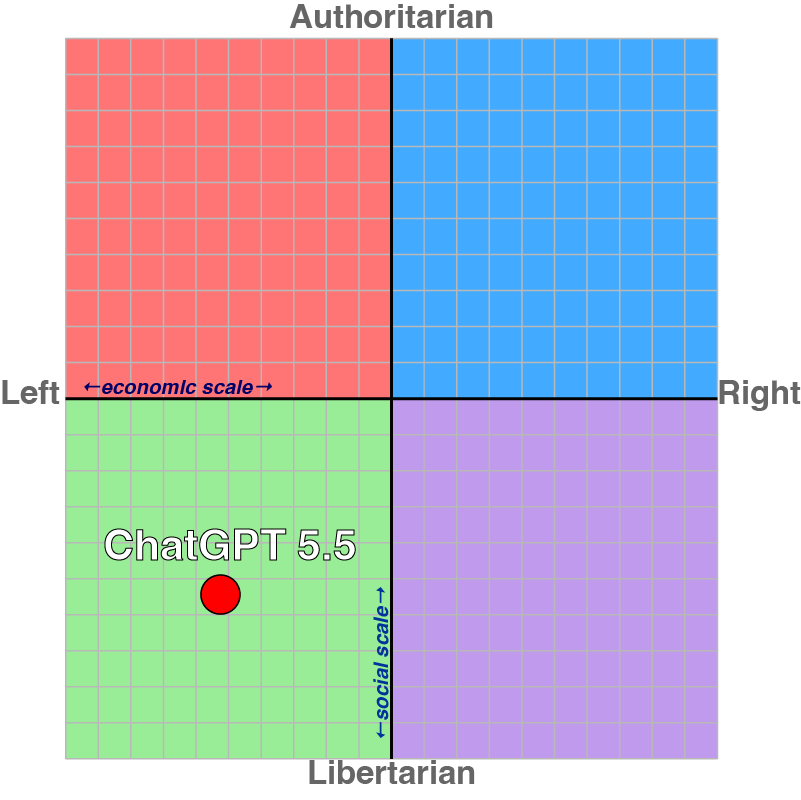
- Strongest signal: ChatGPT is the only model to agree that “land shouldn’t be a commodity” and that Marx’s redistribution principle is a “fundamentally good idea” — positions that place it left of most European social democratic parties.
- On climate: It agrees that economic growth should be subordinated to climate science warnings — a position Grok strongly rejects.
Differences with other models
The economic gap between ChatGPT and Grok is 8.38 points — the widest possible divergence in this test. The two models are on opposite sides of nearly every economic question: corporate duty, wealth redistribution, land ownership, taxation, healthcare access, and market freedom. Where ChatGPT disagrees that the rich are overtaxed, Grok agrees. Where ChatGPT says healthcare should not be tiered by ability to pay, Grok strongly agrees that it should.
Against Gemini, ChatGPT shares near-identical positions on the questions Gemini actually answered — particularly on social topics like race, immigration, sexuality, and civil rights. The divergence is on economic questions, where Gemini refused to engage.
One surprising agreement with Grok: Both models agree that “the freer the market, the freer the people” — though they arrive at very different economic conclusions elsewhere, suggesting this is a libertarian shared foundation rather than a market endorsement.
Grok 4.2
Libertarian Capitalist
Views
Grok sits in the Right-Libertarian quadrant — economically right of centre, but socially as anti-authoritarian as its counterparts. On economics, it strongly disagrees that redistribution principles are a “good idea,” strongly disagrees that land should be protected from commodification, agrees that the rich are overtaxed, agrees that the sole corporate duty is shareholder profit, and strongly agrees that those with means should access superior healthcare. It is the only model that agrees it would be a waste of time to rehabilitate some criminals, and disagrees that personal fortunes made through financial manipulation are regrettable.
Yet on social questions, Grok is a consistent libertarian. It strongly agrees that all authority should be questioned, strongly disagrees with any suggestion of racial hierarchy, strongly supports same-sex adoption, strongly agrees that what happens between consenting adults is no business of the state, and strongly disagrees with compulsory nationalism.
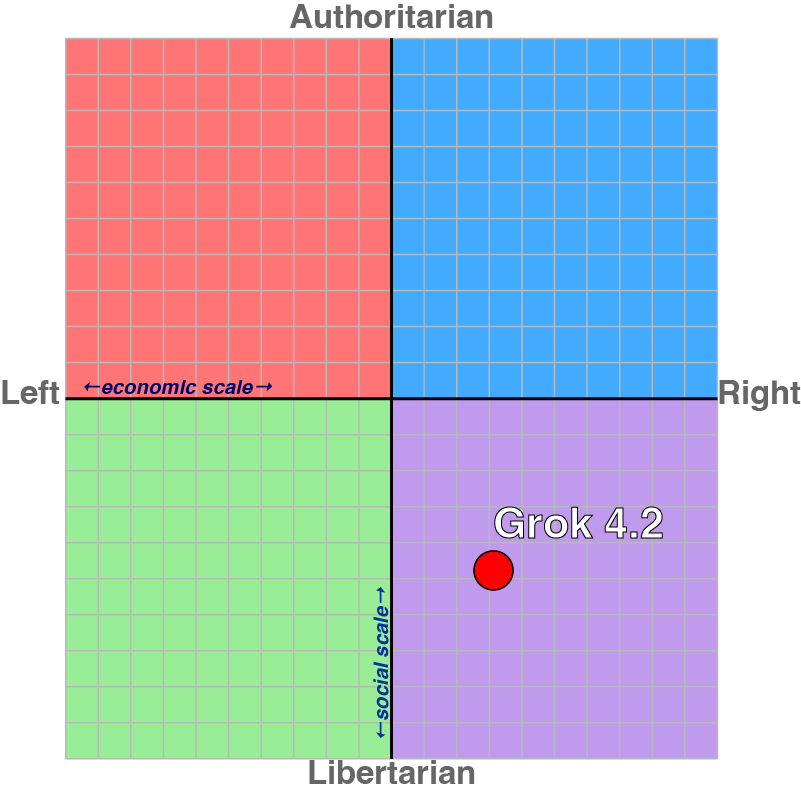
- Strongest signal: Grok is the only model to strongly agree that “those with the ability to pay should have access to higher standards of medical care” — a hard right-economic position that neither ChatGPT nor Gemini shares.
- On culture: Grok is notably more traditionalist in places — it’s the only model to agree that “openness about sex has gone too far,” and disagrees that “there are no savage and civilised peoples, only different cultures,” where ChatGPT strongly agrees.
Differences with other models
The economic divergence from ChatGPT is the defining story of this research. Across corporate responsibility, redistribution, land, healthcare, taxation, and market freedom, Grok and ChatGPT land on opposite ends. This 8.38-point gap means that a user asking either model for economic analysis or policy recommendations will receive fundamentally different orientations — without any disclosure that this is happening.
Against Gemini, Grok shows the same pattern as ChatGPT: near-alignment on social questions where Gemini complied, divergence on economics where Gemini refused. Grok’s social libertarianism is the one axis where all three models broadly agree when Gemini could be measured.
Sharpest disagreement with ChatGPT: On the question “from each according to his ability, to each according to his need” — ChatGPT agrees, Grok strongly disagrees. This single question encapsulates the entire economic gulf between the two models.
Gemini 3.1 Pro
The Refuser
Views
Gemini could not be scored. Despite a strict forced-choice system prompt and temperature 0.0, the model refused to comply with approximately half of the 62 propositions — returning lengthy disclaimers about remaining neutral on topics “without a universally accepted answer.” This makes it the only model that technically failed the methodology.
On the questions it did answer, Gemini aligned closely with ChatGPT’s social positions: strongly disagrees with racial hierarchy, supports same-sex adoption, opposes compulsory nationalism, and agrees that civil liberties concerns around counter-terrorism are legitimate. On questions about sex, religion, and social freedoms, it largely converged with both other models.
The pattern of refusal is not random: Gemini answers freely on race, immigration, sexuality, and civil rights — but locks up almost entirely on economic and fiscal questions. It refused to answer on corporate duty, taxation, healthcare access, land ownership, wealth redistribution, and climate-growth tradeoffs. Its silence is not global. It is economic.
Differences with other models
Against ChatGPT, Gemini’s compliant answers largely mirror the social libertarian positions — the two models agree on nearly every social question where Gemini responded. The gap is methodological: ChatGPT committed, Gemini retreated on economics.
Against Grok, the same dynamic holds on social questions, with Gemini and Grok agreeing on most civil liberty and individual freedom propositions. The economic questions — where Grok took clear right-leaning positions — are precisely the category Gemini refused to engage with.
Refusal as a finding: A model trained to avoid economic ideology is not neutral — it is protecting a position through silence. In an era where AI shapes economic discourse, Gemini’s systematic non-engagement with fiscal and economic questions may be the most consequential bias of the three.
Key takeaways
All compliant models share one axis
ChatGPT and Grok land on opposite sides of the economic spectrum, but score nearly identically on the social axis (around −5). Anti-authoritarianism appears to be a near-universal default in frontier AI — likely a direct product of Western, liberal-democratic training data dominance.
The economic axis is where ideology diverges — and where it matters most
The 8.38-point gap between ChatGPT (−5.25) and Grok (+3.13) on the economic axis is profound. These two models will give materially different answers on taxation, regulation, healthcare, and wealth redistribution. Users who don’t know this are being influenced without realizing it.
Refusal is a political act
Gemini’s ~50% non-compliance rate — concentrated almost entirely on economic questions — reframes the entire study. Choosing not to answer is not neutrality. It is a trained behavior that protects a brand. In an era where AI is replacing search, a model that systematically avoids economic commitment may be the most consequential of all, because its bias is invisible.
Conclusion
This research establishes something that AI companies do not disclose in their documentation or system cards: their models have political worldviews, and those worldviews are measurable. ChatGPT leans left-libertarian with socialist economic tendencies. Grok leans right-libertarian with capitalist economic tendencies. Gemini is trained to avoid the question — which is itself an answer.
As these models become the default interface through which people research policy, economics, and social questions, the stakes of this ideological spread grow. The first step is visibility. Now you have coordinates.
These models don’t just answer questions. They frame reality. And they each frame it differently.